

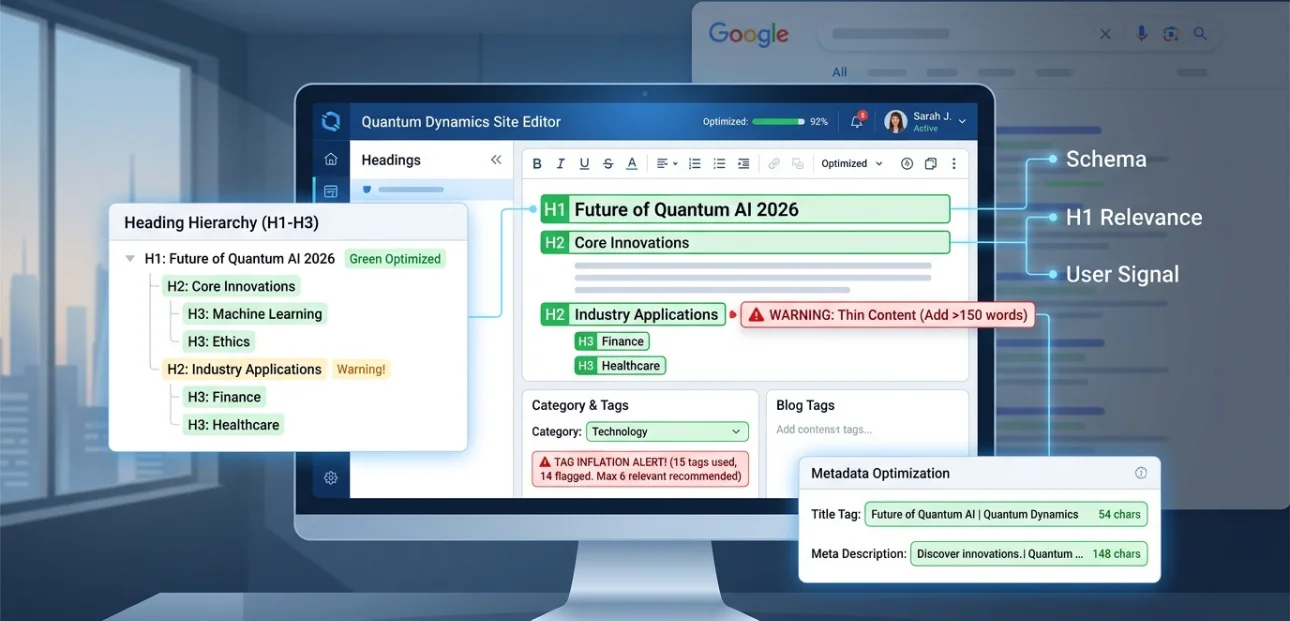
In the early 2000s, "tags" were the secret sauce of the internet. You could load a post with thirty keywords, and Google would eat it up. But it is 2026, and the search landscape has shifted from "keyword matching" to "Entity Intelligence."
Today, many business owners use tags as a disorganized "dumping ground" for keywords, unaware that they are creating "Thin Content" traps that actually dilute their authority.
Here is how to master the technical world of tags across every sector, from Retail to Real Estate, and how to fix the damage you might have already done.
Section 01: The Problem "Tag Inflation"
The most common issue we see is Tag Inflation. A blogger writes about "Digital Marketing" and adds tags for Marketing, SEO, Google, Strategy, Online, Web, and Internet.
The Result? Google sees seven different "Category" pages with almost identical content. This leads to Keyword Cannibalization, where your own pages are fighting each other for the same spot on Google.
Sector-Specific Tag Strategies
Different industries require different tagging "logic." If you use the same strategy for a clothing store as you do for a law firm, your SEO will suffer.
| Sector | Tag Logic | Example |
|---|---|---|
| E-commerce | Attributes & Features | #Waterproof, #Organic-Cotton, #Under-£50 |
| Professional Services | Sub-Niches | #Family-Law, #Commercial-Lease, #Wills |
| Real Estate | Neighborhoods/Amenities | #Balcony, #Near-Tube, #New-Build |
| Hospitality | Dietary/Vibe | #Vegan-Friendly, #Dog-Friendly, #Late-Night |
The Three Main Types of Tags
To solve the SEO puzzle, you need to understand that not all tags are created equal. In 2026, Google prioritizes Semantic Clarity.
1. Header Tags (H1, H2, H3)
These are critical. They are the skeleton of your content.
The Problem: Using H1 tags for "Welcome to our blog."
The Solution: Your H1 must contain your primary keyword. H2s should be the "questions" your readers are asking.
2. Alt Tags (Image SEO)
Google’s AI can "see" images, but it relies on Alt Tags to confirm context.
The Problem: Naming an image IMG_5432.jpg.
The Solution: Use descriptive text: modern-dental-implant-procedure-london.
3. Blog/Category Tags
These are for User Navigation, not for ranking.
The Problem: Creating a tag that only has one post in it.
The Solution: Only create a tag if you plan to write at least 5–10 posts for it. Otherwise, it is "Thin Content."
The "Ghost Page" Solution
If you have 500 tags on your WordPress or Shopify site, you likely have 500 "Ghost Pages", pages with no unique content that Google is wasting its "Crawl Budget" on.
How to Fix It:
- No-Index Your Tags: Tell Google: "You can follow these links to help users find things, but don't show these tag pages in search results."
- Consolidate: Merge 20 small tags into 3 "Super Categories."
- Audit: If a tag hasn't been used in 12 months, delete it.
Quick Tip
Use a "Hierarchical" approach. Category: SEO. Tag: Local SEO. Post: Why Reviews Matter in Hackney. This creates a clear "Knowledge Graph" for Google.
Title Tags - The "Genius" Way
Your Title Tag is the most important 60 characters of your SEO. In 2026, you need to write for the Human first, but the AI second.
| The "Old" Way | The "Genius" 2026 Way |
|---|---|
| London Dentist - Dental Services London | London Dentist: Why 5,000+ Patients Trust Our Care |
| Best SEO Tips for 2026 | Does Your SEO Work? 5 Hard Truths for 2026 |
| Property for Sale Islington | New Builds in Islington: Why Now is the Time to Invest |
Are tags important?
Only if they serve the user. Google’s 2026 algorithm is smart enough to know when you are trying to "game" the system with tags. If a tag helps a reader find what they need faster, it’s an SEO win. If it’s just a keyword-stuffed link, it’s a liability.
Stop tagging for the bot. Start organizing for the human.
Your Action Plan
- Clean House: Delete any tags with only 1 post.
- Standardize: Ensure your H1 and Title Tags match the user's "Search Intent."
- Accessibility: Audit your images, ensure every photo has an Alt Tag that describes the "Action."
Ready to see how your site architecture stacks up? Our audit services at Visual i can identify the "tag traps" that are holding your rankings back.
Reach out for a consultation via contact page — no jargon, just results.






Comments (0)
No comments yet. Be the first to comment.