

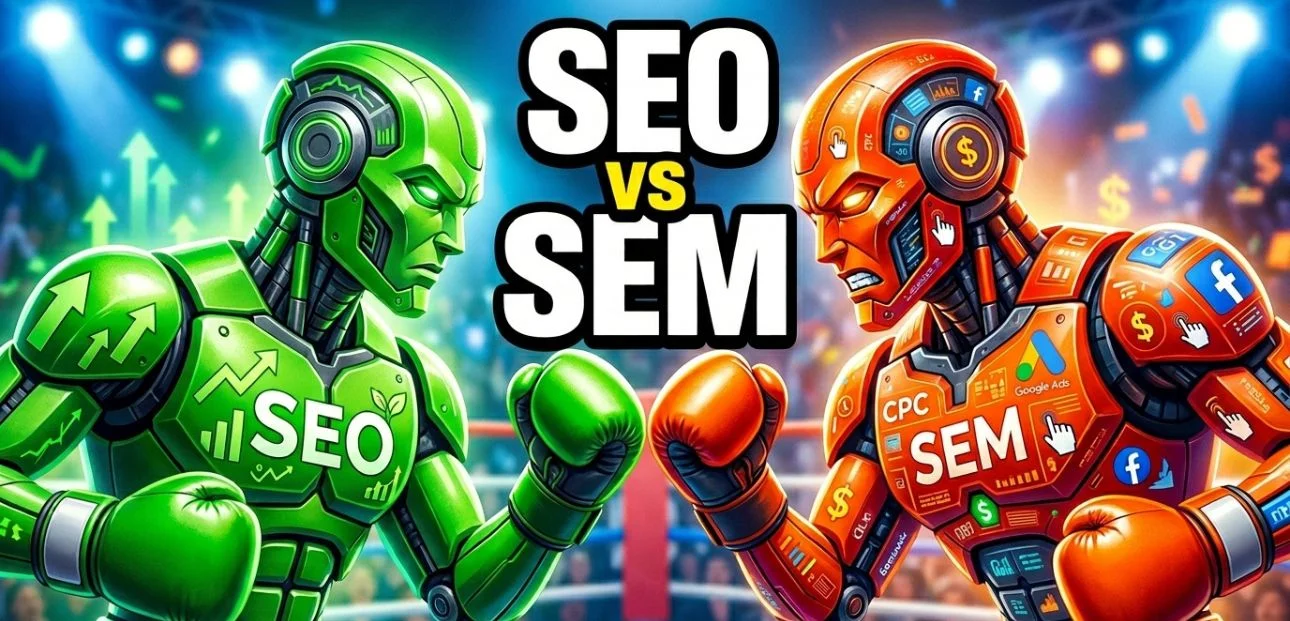
Many business owners struggle to decide whether they should invest in search engine optimisation (SEO) or launch PPC advertising through Google Ads. Should you focus on long-term organic rankings, or is a short-term paid search campaign the smarter move? The answer depends on your marketing goals, budget allocation, competition level, and desired return on investment (ROI).
At Visual i, we often help brands understand how SEO and SEM work together within a results-driven digital marketing strategy. In this guide, we’ll break down the key differences, advantages, costs, and use cases of SEO vs SEM, so you can make an informed decision for sustainable business growth.
What Is SEO (Search Engine Optimisation)?
Search engine optimisation (SEO) is the process of improving your website’s visibility in the organic results of search engines like Google. Unlike paid advertising, SEO focuses on earning traffic naturally by aligning your website with Google’s ranking factors, search intent, and high-value keywords.
When discussing SEO vs SEM marketing, SEO represents the long-term, sustainable approach. It involves optimising your website’s structure, content, and authority so that it appears higher on the search engine results page (SERP) without paying for each click.
A strong SEO strategy typically includes:
- On-page SEO - Optimising page titles, meta descriptions, headings, internal links, and keyword placement.
- Technical SEO - Improving site speed, mobile responsiveness, crawlability, and overall website performance.
- Content marketing - Creating valuable, keyword-optimised content that satisfies user search intent.
- Off-page SEO and backlink building - Increasing domain authority through high-quality external links.
The main goal of SEO is to generate organic traffic, build brand credibility, and establish long-term online visibility. While results don’t happen overnight, SEO delivers compounding growth over time and often provides a stronger marketing ROI in the long run.
For UK businesses looking to strengthen their digital presence, our SEO service is particularly powerful for local visibility, competitive industries, and sustainable lead generation. However, it requires consistent optimisation, monitoring of algorithm updates, and ongoing performance tracking to maintain rankings.
What Is SEM (Search Engine Marketing)?
Search engine marketing (SEM) is a digital marketing strategy that focuses on gaining visibility in search engines through paid advertising. While SEO targets organic rankings, SEM typically refers to pay-per-click (PPC) advertising, where businesses bid on keywords to appear at the top of the search engine results page (SERP).
When comparing SEO vs SEM marketing, SEM delivers immediate visibility. Instead of waiting months to build organic authority, businesses can launch targeted Google Ads campaigns and start driving traffic almost instantly.
With SEM, advertisers pay a cost per click (CPC) each time a user clicks on their advert. The position of the ad depends on several factors, including:
- Keyword bidding strategy
- Quality Score
- Ad relevance
- Landing page optimisation
- Competition level
A well-structured SEM campaign involves more than simply selecting keywords. It requires strategic audience targeting, compelling ad copy, conversion-focused landing pages, and continuous campaign performance tracking using analytics and reporting tools.
One of the main advantages of SEM is speed. It is ideal for:
- New website launches
- Time-sensitive promotions
- Product launches
- Competitive industries
- Immediate lead generation
However, unlike SEO, SEM traffic stops the moment you pause your ad campaigns. This makes it a powerful short-term traffic solution, but one that requires ongoing marketing budget allocation.
For many UK businesses, SEM forms part of a broader performance marketing strategy, particularly when rapid growth or measurable conversions are the priority. When managed professionally, paid search campaigns can generate strong returns and provide valuable keyword data that also informs long-term SEO efforts.
SEO vs SEM Marketing: The Key Differences Explained
When evaluating SEO vs SEM marketing, the core difference comes down to organic visibility versus paid visibility. Both strategies aim to increase website traffic and improve online presence, but they operate in fundamentally different ways.
1. Traffic Source
SEO generates organic traffic by improving rankings naturally within the search engine results page (SERP). SEM generates paid traffic through PPC advertising, typically via Google Ads. SEO builds authority over time, while SEM places your business at the top of search results instantly, as long as you’re paying for clicks.
2. Cost Structure
SEO does not require paying per click, but it does require investment in content marketing, technical optimisation, and ongoing strategy. SEM operates on a pay-per-click (PPC) model, meaning you pay a cost per click (CPC) every time someone engages with your advert. While SEO is often viewed as “free traffic”, in reality it requires consistent resource investment. SEM, on the other hand, offers predictable budget control but ongoing ad spend.
3. Speed of Results
SEO is a long-term digital marketing strategy. Results can take several months, depending on competition and keyword difficulty. SEM delivers immediate visibility and can generate leads within days of launching a campaign. For businesses needing quick results or testing new markets, SEM provides rapid data and faster conversion tracking.
4. Sustainability
SEO provides compounding growth. Once you achieve strong organic rankings, traffic can continue without additional cost per visitor. SEM stops generating traffic as soon as your ad campaigns are paused. This makes SEO more sustainable long-term, while SEM is ideal for short-term performance boosts.
5. Click-Through Rates and Trust
Users often trust organic rankings more than paid adverts. High organic visibility can strengthen brand credibility and authority. However, SEM ads appear above organic listings and can capture high-intent search traffic, especially for commercial keywords.
6. Strategy and Data Insights
Both strategies rely on keyword strategy, search intent optimisation, and performance tracking. Interestingly, SEM campaigns often provide valuable keyword data that can strengthen SEO content planning. When used together, they create a more complete and scalable marketing strategy.
In Simple Terms
- SEO - Long-term organic growth
- SEM - Immediate paid visibility
- Best approach - Strategic combination of both
| Feature | SEO (Search Engine Optimization) | SEM (Search Engine Marketing) |
|---|---|---|
| Primary Goal | Long-term authority & organic traffic | Immediate leads & visibility |
| Cost Model | No cost-per-click; high resource investment | Pay-per-click (PPC); direct ad spend |
| Time to Results | 3–12 months (Compounding growth) | Instant (Once the campaign is live) |
| Sustainability | High (Traffic remains if work pauses) | Low (Traffic stops when budget stops) |
| User Trust | High (Organic listings viewed as "earned") | Moderate (Clearly marked as "Sponsored") |
| Best For | Brand building & lowering long-term CAC | New launches & high-competition sales |
SEO vs SEM: Pros and Cons
When deciding between SEO vs SEM marketing, it’s important to understand the advantages and limitations of each approach. Both strategies play a vital role in a well-rounded digital marketing strategy, but the right choice depends on your objectives, timeline and budget.
The Pros of SEO (Search Engine Optimisation)
- Long-Term Organic Growth: SEO delivers sustainable traffic. Once your website achieves strong organic rankings, you can continue generating visitors without paying for each click.
- Higher Credibility and Trust: Users often trust organic search results more than paid adverts. Appearing naturally in Google builds brand authority and long-term credibility.
- Stronger Marketing ROI Over Time: Although SEO requires investment in content marketing, technical SEO and backlink building, it often produces a higher return on investment in the long run.
- Compounding Results: Optimised content continues to attract traffic months, and even years, after publication, especially when aligned with search intent optimisation.
The Cons of SEO
- Slower Results: SEO is a long-term strategy. Depending on keyword competition and industry, results can take several months.
- Algorithm Dependency: Search engines regularly update their algorithms. Without ongoing monitoring and optimisation, rankings can fluctuate.
- Ongoing Effort Required: SEO is not a one-time task. It requires continuous content updates, technical improvements, and authority building.
The Pros of SEM (Search Engine Marketing)
- Immediate Visibility: With SEM and PPC advertising, your business can appear at the top of the search engine results page almost instantly.
- Precise Targeting: SEM allows you to target specific audiences, locations, devices, and demographics, making it ideal for UK businesses targeting local or national markets.
- Measurable Performance: Paid search campaigns provide clear analytics and reporting. You can track click-through rate (CTR), cost per click (CPC), conversions, and overall campaign performance in real time.
- Scalable and Flexible: Budgets can be adjusted quickly, making SEM ideal for seasonal promotions, product launches, and competitive markets.
The Cons of SEM
- Ongoing Ad Spend: Traffic stops when you pause your campaigns. Unlike SEO, SEM does not generate compounding organic growth.
- Increasing Competition: In competitive industries, cost per click can rise significantly, impacting profitability.
- Lower Perceived Trust: Some users intentionally skip paid adverts in favour of organic results.
The Real Insight: It’s Not SEO or SEM
For many businesses across the UK, the debate around SEO vs SEM marketing shouldn’t be about choosing one over the other. Instead, it should focus on how both strategies complement each other within a cohesive performance marketing strategy.
- SEO builds long-term authority and organic visibility.
- SEM drives immediate traffic and short-term conversions.
When aligned correctly, they create a powerful, scalable digital growth system.
Which Is Better for Your Business: SEO or SEM?
The answer to the SEO vs SEM marketing question depends entirely on your business goals, timeline, industry competition and marketing budget. There isn’t a one-size-fits-all solution. Instead, the right approach depends on what you’re trying to achieve. You can check our portfolio to see how we deliver results.
Choose SEO If:
- You want long-term organic traffic growth
- You’re building brand authority in your industry
- You want sustainable lead generation
- You’re focused on long-term marketing ROI
- You operate in a market where trust and credibility matter
Choose SEM If:
- You need immediate traffic or enquiries
- You’re launching a new product or service
- You’re entering a competitive marketplace
- You want fast, measurable campaign performance
- You’re testing new keywords or offers
The Smartest Strategy: Combine SEO and SEM
For most growing businesses, the real power lies in integrating both strategies into a unified digital marketing plan. Learn more about us and our methodology.
Strategic Marketing Requires Expertise
Understanding the difference between search engine optimisation vs search engine marketing is one thing, implementing them effectively is another. A successful strategy requires keyword research, technical optimisation, and data-driven management.
SEO vs SEM Cost Comparison
One of the most common questions businesses ask is: Which one is more cost-effective? The answer depends on how you measure cost, short term versus long term.
The Cost of SEO
SEO does not involve paying for each click, but it does require strategic investment. Costs typically include keyword research, on-page optimisation, and content marketing. For UK businesses, monthly SEO services can vary, but the cost per visitor decreases significantly over time.
The Cost of SEM
SEM operates on a pay-per-click (PPC) model. Your total spend depends on keyword competition, quality score, and your ad budget. While it provides predictability, your traffic stops once the budget is exhausted.
Long-Term Value Comparison
SEO often delivers a stronger long-term marketing ROI and reduces dependency on paid ads, while SEM offers faster lead generation and immediate data insights.
Can SEO and SEM Work Together?
Yes, combining SEO and SEM marketing can be one of the most effective strategies for UK businesses. Keyword insights from SEM can inform your SEO content strategy, and appearing in both paid and organic listings increases brand trust and overall SERP visibility.
Integrate SEO and SEM for Maximum Results
In the debate of SEO vs SEM marketing, the smartest approach is using both strategically. SEO delivers sustainable organic growth while SEM drives immediate traffic. At Visual i, we help UK businesses implement tailored strategies that ensure every pound of your marketing budget drives measurable growth.
If you’re ready to dominate your market, increase website traffic, and generate more leads, get in touch with our expert team today and let us create a results-driven strategy that works for your business.





Comments (0)
No comments yet. Be the first to comment.