

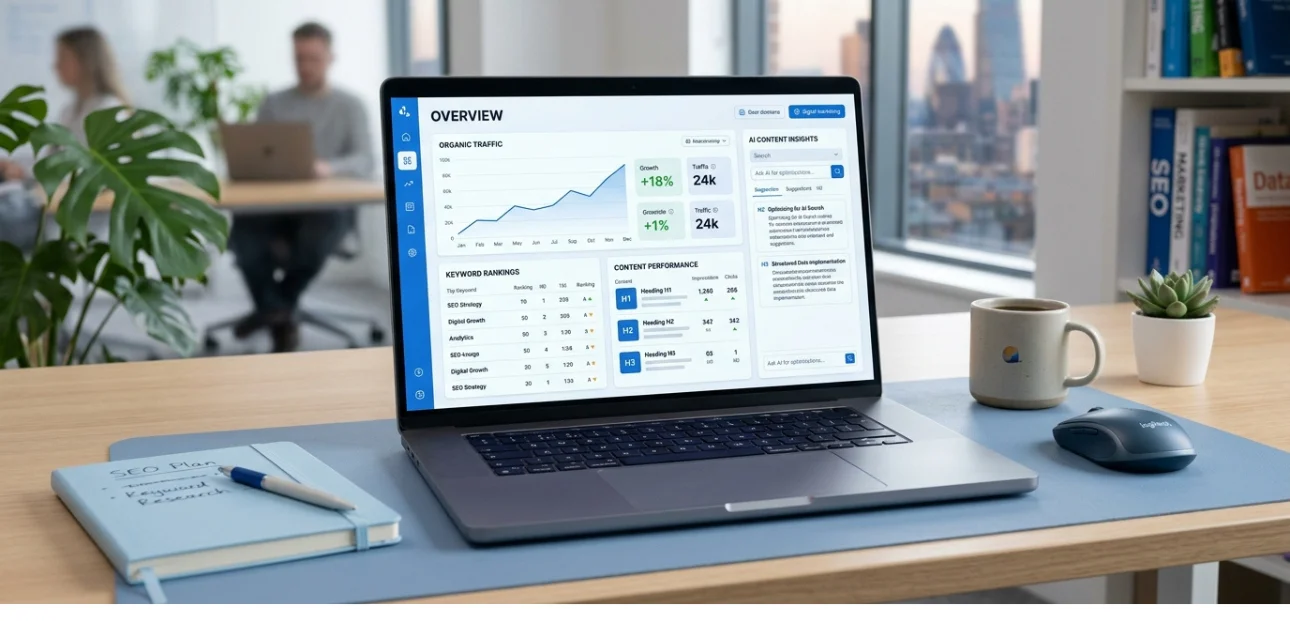
If you’ve been following the "old" SEO advice of 2022, you’ve probably noticed something frustrating: your traffic is flatlining, even though your keywords are "optimised."
In 2026, the reality of search has shifted. We are no longer just in a "search engine" world; we are in an "answer engine" world. Between Google’s AI Overviews (SGE) and zero-click searches, the way people interact with your site has changed. On-page SEO isn't about "tricking" a bot anymore, it's about surviving a landscape where 60% of people don't even bother clicking on a website.
Here is what’s actually happening on the ground and why your on-page strategy is your only remaining leverage.
The Death of the "Click" (Zero-Click Reality)
The biggest shift in 2026 is the Zero-Click Search. Google now tries to answer the user's question directly on the search page using AI.
The Reality: If your on-page content is a 2,000-word wall of text with the answer buried at the bottom, you lose.
The Solution: You must write in "Snippet-Ready Blocks."
* Action: Put the direct answer to the main question in the first 50 words.
Result: Even if they don't click, Google cites you as the source. That brand citation is the new "ranking."
What People Are Actually Doing (And Why It Fails)
Most business owners are still "Keyword Stuffing" like it’s 2015. They think if they say "Best Dentist Dagenham" five times, they win.
The Reality of 2026 Behavior:
| What People Do | Why It Fails Now | The Genius Fix |
|---|---|---|
| Writing for Bots | AI can detect "shallow" content in milliseconds. | Information Gain: Add a unique stat or a personal case study that isn't anywhere else on the web. |
| Ignoring "Micro-Moments" | People search for "near me open now" or "Invisalign cost vs veneers." | Intent Mapping: Create dedicated H2 sections that specifically compare those two things. |
| Using Stock Text | Template copy from web developers is now a "spam signal." | Human-Centric Copy: Use the "I" or "We" voice. Mention local London landmarks or specific street names. |
Solving the "Lurker" Problem
In 2026, users are "lurkers." They scan your page for 5 seconds and leave. If your on-page SEO doesn't solve their problem immediately, your Bounce Rate will skyrocket, and Google will demote you.
The "User Experience" Audit:
Problem: Your page is slow because of massive 4K images.
Solution: Switch to WebP formats. It’s the difference between a 3-second load and a 0.5-second load.
Problem: Your "Call to Action" is a tiny link at the bottom.
Solution: Use Sticky Navigation. As the user scrolls, the "Book Now" or "Get a Quote" button stays visible.
Technical Clarity = AI Citability
AI models (like Gemini and GPT-4) crawl your site to learn. If your HTML is a mess, they ignore you. On-page SEO is essentially "translating" your business for these AI agents.
| On-Page Element | 2026 Purpose |
|---|---|
| Schema Markup | Tell the AI: "This is a price," "This is a review," "This is an address." |
| H1 - H3 Hierarchy | Acts as a Table of Contents for the AI to summarize your page. |
| Alt Text | Helps "Vision AI" understand your "Before & After" photos. |
Useful or Useless?
In 2026, Why on-page SEO is important comes down to one thing: Utility.
Google is no longer a librarian pointing to a book; it’s an assistant giving an answer. If your on-page SEO doesn't make your site the most "citeable" and "useful" source in London, you will be replaced by a competitor who is.
Stop trying to rank for a keyword. Start trying to own the answer.
Next Step: Look at your top-performing page on your mobile phone. Can you find the answer to your customer's biggest problem without scrolling? If not, your on-page SEO is failing you.
Want expert help? Explore our SEO Service or contact us today.





Comments (0)
No comments yet. Be the first to comment.